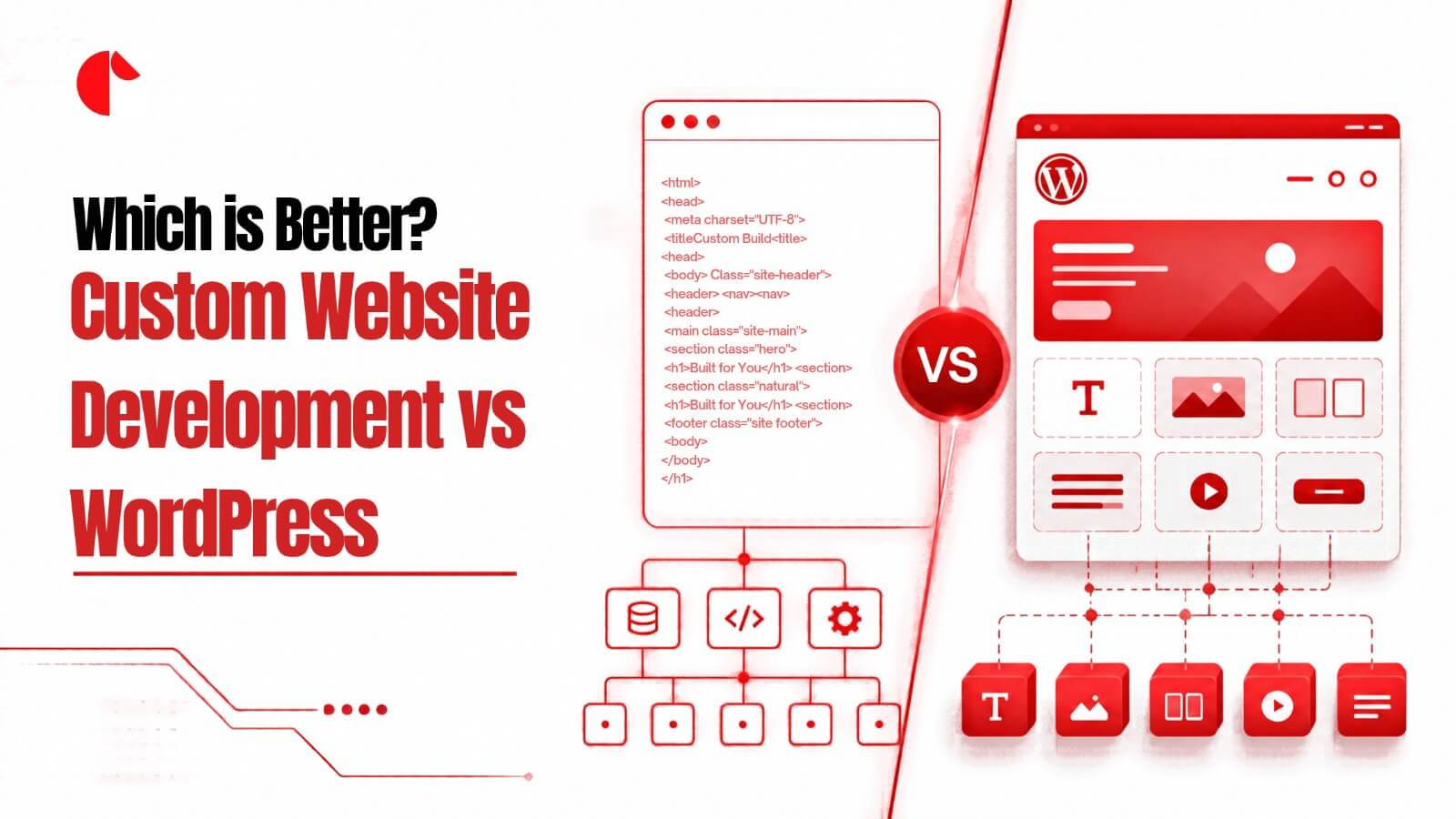
CUSTOM WEBSITE DEVELOPMENT VS WORDPRESS: WHICH IS BETTER FOR YOUR BUSINESS?
Custom Website Development Vs Wordpress
Advantage of Custom website development · Advantage of WordPress website development · Custom website development · Custom Website Development vs WordPress · WordPress Website Development
WHAT IS CUSTOM WEBSITE DEVELOPMENT?
Custom website development is the process of designing and engineering a website according to a business's specific functional, technical and commercial requirements. Rather than relying primarily on a prebuilt website template, developers create the required architecture, interfaces, business logic and integrations for the intended application. Depending on the project, technologies may include HTML, CSS, JavaScript, React, Next.js, Laravel, Python and database systems. Custom development can support everything from sophisticated corporate websites to customer portals, business management platforms and specialized web applications.KEY ADVANTAGES OF CUSTOM WEBSITE DEVELOPMENT

- Purpose-built functionality Features can be developed around specific business processes, including quotation systems, customer dashboards, booking workflows, user permissions and automated reporting.
- Greater architectural control Developers can select an appropriate technology stack, define data structures and establish application logic according to project requirements.
- Integration flexibility Custom applications can connect with CRM platforms, ERP systems, payment gateways, third-party APIs and internal business applications.
- Performance engineering The architecture can be optimized around actual application requirements, including database operations, caching, server-side processing and front-end delivery.
- Long-term adaptability A properly designed application can accommodate new features and evolving workflows without requiring the business to depend exclusively on standard themes or plugins.
WHAT IS WORDPRESS WEBSITE DEVELOPMENT?
WordPress is an open-source content management system (CMS) that enables businesses to create, publish and manage website content through an administrative interface. Its ecosystem includes themes, plugins, APIs and development tools that support a broad range of website requirements. Businesses can choose an existing theme, customize a suitable theme or commission a custom WordPress theme designed around their brand. WordPress is commonly used for corporate websites, professional service providers, blogs, content marketing platforms and many other business applications.KEY ADVANTAGES OF WORDPRESS WEBSITE DEVELOPMENT

- Efficient content management Authorized users can update pages, publish articles, manage media and maintain website content without routinely editing source code.
- Established functionality Existing themes, plugins and CMS features can reduce the amount of foundational development required for standard websites.
- Flexible customization WordPress supports customized themes, page templates, plugins and integrations, allowing businesses to tailor the platform to their needs.
- SEO and publishing tools SEO plugins and established publishing workflows can help teams manage metadata, sitemaps and ongoing content optimization.
- Established support ecosystem Businesses can access a broad community of developers, documentation, extensions and maintenance services.
CUSTOM WEBSITE DEVELOPMENT VS WORDPRESS: A DETAILED COMPARISON
| Factor | Custom Website Development | WordPress Development |
|---|---|---|
| Initial Investment | Generally higher for comparable standard requirements | Often lower for standard websites |
| Development Timeline | Depends on architecture and feature complexity | Often shorter for conventional websites |
| Design Control | Extensive control over the complete implementation | Highly customizable within the WordPress ecosystem |
| Business-Specific Features | Developed around defined requirements | Supported through plugins and custom development |
| Content Management | Requires a CMS or administrative interface if needed | Built-in content management |
| SEO | Requires deliberate technical implementation | Supports SEO plugins and publishing tools |
| Performance | Can be optimized for the specific application | Can achieve strong performance with appropriate optimization |
| Security | Depends on architecture, coding and maintenance | Depends on configuration, hosting, extensions and maintenance |
| Integrations | Suitable for specialized workflows and APIs | Supports common integrations and custom connections |
| Scalability | Can be designed for application-specific growth | Can scale effectively with appropriate architecture and infrastructure |
| Maintenance | Requires support for the chosen technology stack | Requires core, theme and plugin maintenance |
| Typical Applications | Specialized platforms and complex business applications | Corporate websites, blogs and content-led websites |
CUSTOM WEBSITE DEVELOPMENT COSTS
Custom development typically involves requirements analysis, interface design, architecture planning, programming, integration, testing, and deployment. Project costs are influenced by:- Functional and technical complexity
- Number of unique page templates
- Custom application features
- Database and API integrations
- Authentication and access controls
- Testing and deployment requirements
- Maintenance and future development
WORDPRESS WEBSITE DEVELOPMENT COSTS
WordPress can reduce initial development effort because the CMS and many common features are already available. Costs may include design, theme customization, premium plugins, hosting, content migration, integrations, and ongoing maintenance. However, a WordPress project can become expensive when it requires extensive custom plugins, complex integrations, or significant modifications to existing functionality.WHICH APPROACH OFFERS BETTER VALUE?
WordPress is often cost-effective for standard business websites and content-led projects. Custom development may offer better value when specialized functionality is essential to the company's operations. A meaningful comparison should include the total cost of ownership: initial development, hosting, licensing, security, maintenance, technical support, and future enhancements.DESIGN FLEXIBILITY AND USER EXPERIENCE
A business website should reflect its brand identity while making it easy for visitors to find information and complete relevant actions. Custom development allows the entire interface and user journey to be designed around the intended audience. This is useful for businesses requiring distinctive interfaces, complex dashboards, personalized experiences, or specialized workflows. WordPress also supports extensive customization through themes, page-building tools, and custom development. A professionally designed WordPress website can provide a unique visual identity without relying on a generic template. The distinction is not whether WordPress can support professional design. It is whether the required experience can be delivered efficiently within the chosen architecture.WEBSITE PERFORMANCE AND TECHNICAL EFFICIENCY
Website performance affects user experience, conversion opportunities, and technical SEO. Slow loading times can frustrate visitors, particularly on mobile devices and connections with limited bandwidth. Custom websites can be optimized around their specific functionality, allowing developers to control scripts, database queries, rendering, caching, and application resources. WordPress websites can also deliver strong performance when built with an efficient theme, suitable hosting, optimized images, effective caching, and carefully selected plugins. In both cases, unnecessary scripts, oversized images, inefficient database operations, and inadequate hosting can undermine performance. Businesses should assess actual results using tools such as Google PageSpeed Insights and evaluate Core Web Vitals rather than assuming one development approach will automatically be faster.SEARCH ENGINE OPTIMIZATION AND ORGANIC VISIBILITY
SEO should be considered during website planning and development, rather than added only after launch. A technically sound website helps search engines discover, crawl, understand and index its content. Organic visibility also depends on content quality, search intent, competition, website authority and relevance to the target audience.SEO WITH CUSTOM DEVELOPMENT
- URL structure and canonical tags
- Title tags and meta descriptions
- Heading hierarchy and semantic HTML
- XML sitemaps and robots directives
- Structured data and schema markup
- Internal linking and navigation
- Responsive rendering and image optimization
- Page speed and Core Web Vitals
SEO WITH WORDPRESS
WordPress provides an established publishing workflow for creating service pages, articles, landing pages and other content. SEO plugins can simplify metadata management, sitemap generation and selected structured-data tasks. However, plugin configuration, page architecture and technical quality still require attention. Duplicate metadata, unnecessary indexable URLs, conflicting schema and poorly structured content can affect a WordPress website just as technical mistakes can affect a custom application.WHICH PLATFORM IS BETTER FOR SEO?
Both can support effective SEO. WordPress is particularly convenient for businesses that publish content frequently, while custom development offers flexibility over technical architecture. For businesses targeting competitive searches such as website development company in Dubai, the quality of the website's content, technical implementation, internal linking, and overall authority matters more than the platform alone.SECURITY, RELIABILITY AND MAINTENANCE
Website security is an ongoing operational responsibility, not a one-time development task. Custom applications can implement security controls around authentication, permissions, data validation and application-specific requirements. They still require secure coding practices, dependency updates, monitoring, backups and vulnerability testing. WordPress requires appropriate management of core updates, themes, plugins, hosting configuration and administrative access. Businesses should remove unused extensions, maintain tested backups, use strong authentication and apply security updates promptly. For either approach, an effective maintenance plan should identify who is responsible for updates, incident response, monitoring, recovery and technical support.SCALABILITY AND FUTURE BUSINESS REQUIREMENTS
A website should accommodate anticipated growth without introducing unnecessary complexity. Custom development can be designed around specialized workflows, complex data relationships, high-volume transactions and integrations with internal systems. This can be valuable for companies building digital products or applications that support core operations. WordPress can also support substantial traffic, growing content libraries and many business requirements. Appropriate hosting, caching, database optimization and infrastructure planning can improve its ability to handle increasing demand. The distinction becomes more important when a website evolves into a complex application with interconnected workflows, advanced permissions or specialized processing requirements.CONTENT MANAGEMENT AND MARKETING OPERATIONS
For businesses investing in SEO and content marketing, the ability to publish and update content efficiently is an important consideration. WordPress provides a built-in administration interface for managing pages, articles, images and other content. Marketing teams can usually perform routine updates without requiring a developer for each change. Custom websites can provide similar capabilities through a custom CMS or a separate content management platform. However, the editing experience must be included in the requirements and developed appropriately. For businesses with frequent publishing schedules, multiple content contributors or extensive service and location pages, the content management workflow should be evaluated before selecting the platform.THIRD-PARTY INTEGRATIONS AND AUTOMATION
Modern business websites often connect with CRM systems, ERP platforms, payment providers, analytics tools and other operational applications. Custom development allows integrations to be structured around specific data flows, business rules and error-handling requirements. This is particularly valuable when several internal systems must work together. WordPress supports a broad range of common integrations through plugins and APIs. Where a reputable, compatible plugin already meets the requirements, implementation can be more efficient. Complex integrations may still require custom development regardless of the platform.DEVELOPMENT TIMELINE AND TIME TO MARKET
WordPress can often shorten development timelines for standard websites because its CMS functionality, themes, and established extensions reduce foundational work. Custom development requires time for architecture planning, design, programming, integration and testing. The timeline varies considerably depending on project complexity. A simple custom website may be straightforward to deliver, while a complex platform with several user roles, automated workflows and third-party integrations can require a much longer development cycle. Businesses should establish clear requirements and prioritize essential features before requesting proposals. Launching quickly is useful only when the resulting solution supports the intended business objectives.OWNERSHIP AND LONG-TERM FLEXIBILITY
Long-term flexibility depends on documentation, contractual arrangements, access to source code and the ability to maintain the chosen technology. With custom development, businesses should clarify source-code ownership, licensing, documentation, repository access and responsibility for future support. WordPress benefits from a broad developer ecosystem, which can make it easier to find maintenance and development resources. Businesses should still review plugin licensing, hosting access and third-party service dependencies.WHEN SHOULD YOU CHOOSE CUSTOM WEBSITE DEVELOPMENT?
Custom website development is a suitable choice when your business requires tailored functionality, specialized workflows, or greater control over its digital infrastructure. It allows developers to build a solution around your operational requirements rather than adapting your processes to a predefined platform. Consider custom website development if your business needs specialized customer or employee portals, complex booking and quotation workflows, advanced dashboards, or integrations with proprietary and legacy systems. It can also support application-specific security requirements, unique user experiences, and digital products designed to differentiate your business from competitors. For businesses with complex operations or long-term expansion plans, a custom solution offers flexibility to evolve alongside changing requirements.WHEN SHOULD YOU CHOOSE WORDPRESS?
WordPress is a practical option for businesses that need a professional website with manageable development costs and a straightforward content management experience. Its extensive themes, plugins, and built-in publishing features make it suitable for launching and maintaining a wide range of business websites. Choose WordPress for corporate websites, professional services websites, blogs, content marketing platforms, and lead-generation landing pages. It can support standard enquiry forms, common third-party integrations, and an accessible dashboard that allows teams to update pages and publish content without extensive technical knowledge. For small and medium-sized businesses looking to establish an online presence efficiently, WordPress can provide a flexible starting point, provided the selected themes, plugins, security measures, and hosting meet the project's requirements.IS CUSTOM WORDPRESS DEVELOPMENT A PRACTICAL MIDDLE GROUND?
Businesses do not necessarily have to choose between an off-the-shelf WordPress theme and a completely custom-coded platform. Custom WordPress development combines the CMS with a tailored design, custom functionality and selected integrations. It can provide a distinctive brand experience while allowing marketing teams to manage content independently. This approach is particularly suitable for businesses that require customized page templates, specific publishing workflows and selected business integrations without the overhead of building a separate CMS. For more complex requirements, a headless CMS architecture may provide additional flexibility, although it introduces extra development and maintenance considerations.CONCLUSION
The choice between custom website development and WordPress should reflect your business requirements, operational priorities and long-term digital strategy. WordPress offers an established content management foundation for businesses that need a professional website with efficient publishing capabilities. Custom website development provides greater control over application architecture and specialized functionality when standard tools are insufficient. For businesses in Dubai and across the UAE, the best solution is the one that delivers the necessary functionality, supports a positive user experience and remains manageable as business requirements evolve. 
FAQs
What next?
View All
CUSTOM WEBSITE DEVELOPMENT VS WORDPRESS: WHICH IS BETTER FOR YOUR BUSINESS?
AI Website Builders vs Professional Web Developers: Which Is Better?
How to Choose a Web Development Company in Dubai
10 Signs Your Business Website Needs an Upgrade
Website Development Cost in Dubai: Complete Guide for Businesses
WooCommerce vs Shopify: Which One Actually Wins?
Web Designer vs Web Developer: What’s the Real Difference
Best SEO Agency in Dubai – Top 5 agencies with proven case studies

How to Improve Website Speed and Performance

Difference Between Dynamic & Static Website